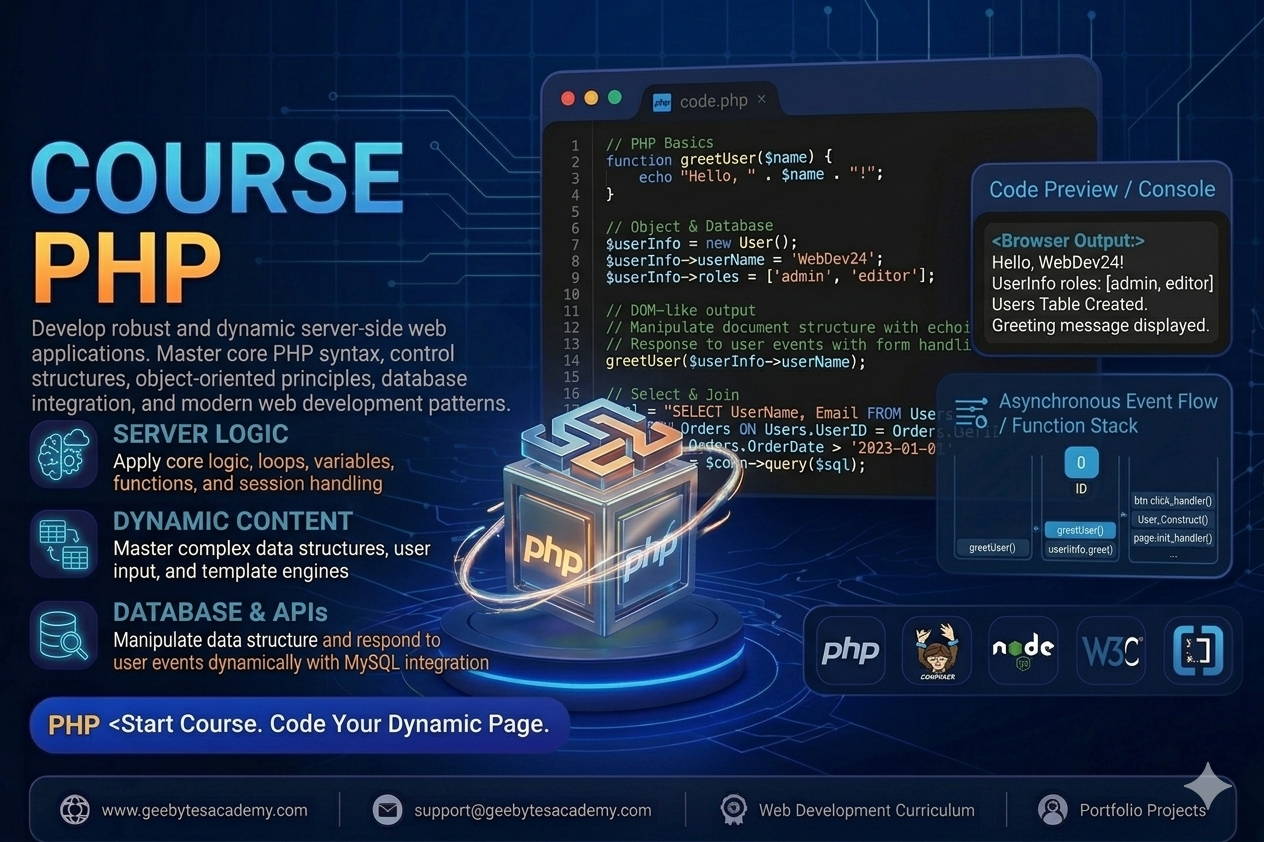
Course Overview
Level: Beginner to Advanced
Prerequisites: Solid understanding of HTML structure and basic SQL database concepts
Goal: Master server-side programming, form handling, session security, object-oriented PHP architecture, and database integrations.
Module 1: PHP Foundations and Environment Setup
Introduction to the Server Side: Understanding client-server architecture and how a web server interprets PHP before serving HTML to the browser.
Development Environment Setup: Configuring local development servers like XAMPP or Laragon and verifying the PHP installation.
Basic Syntax and Echoing: Managing opening and closing PHP tags, statement terminators, and outputting content via echo and print.
Variables and Constants: Declaring dynamic variables with the dollar sign and setting unchangeable application values with the define function.
Data Types and Sizing: Working with strings, integers, floats, booleans, arrays, objects, and null values.
Module 2: Control Flow, Logic, and Arrays
Conditional Evaluation: Directing application flow using if, else, elseif, and switch statements.
Looping Mechanisms: Automating repetitive tasks using for, while, do-while, and foreach for data rendering.
Working with Arrays: Building and manipulating indexed arrays, associative key-value arrays, and multi-dimensional data structures.
Array Core Functions: Transforming data lists using array-push, array-pop, count, in-array, and array-merge.
Module 3: Functions and Variable Scope
Declaring Custom Functions: Building reusable blocks of code with custom naming parameters and return statements.
Type Hinting and Return Types: Writing clean, modern PHP by explicitly enforcing data types for input parameters and outputs.
Variable Scope Management: Navigating global vs local variable execution spaces and leveraging the global keyword.
Built-In Helper Functions: Utilizing string formatting functions, mathematical calculators, and real-time date-time utilities.
Module 4: Form Handling and User Input Processing
Superglobal Variables: Working with system-level variables like SERVER, GET, and POST.
Form Submission Processing: Safely capturing user entry data transmitted from HTML forms.
Data Sanitization: Scrubbing user inputs using filter-var and htmlspecialchars to block malicious code injection attacks.
Form Validation Patterns: Implementing mandatory field checking, email verification strings, and numerical range verification logic.
Module 5: State Management, Cookies, and Sessions
Understanding Stateless Protocol: How HTTP functions and why data tracking layers are required.
PHP Sessions: Initiating secure tracking using session-start, storing global variables, and destroying user sessions on logout.
Cookie Mechanics: Setting temporary or permanent browser client trackers using setcookie and reading stored values safely.
Authentication Security: Restricting page views to registered users by tracking valid session state flags.
Module 6: Object-Oriented PHP OOP
Introduction to Classes and Objects: Building application blueprints with custom properties and internal methods.
The Constructor Method: Automatically priming new objects with custom data payloads using the construct method.
Access Modifiers: Enforcing strict data encapsulation using public, private, and protected visibility states.
Inheritance and Polymorphism: Extending parent classes to child classes using the extends keyword to reuse architectural logic.
Module 7: Database Integration with MySQL
Connecting via PDO: Establishing secure database connections using the modern PHP Data Objects layer.
Prepared Statements Architecture: Securing web applications against SQL Injection vulnerabilities using parameter binding.
CRUD Data Operations: Writing script routines to Create, Read, Update, and Delete database records directly from user dashboards.
Dynamic Layout Population: Fetching rows from database structures and looping them clean HTML tables and card containers.
Capstone Portfolio Projects
To graduate from this course, students will build two real-world, backend-driven applications demonstrating backend development mastery:
Project 1: A Secure User Authentication and Membership Portal
Students will build a complete user registration and login engine. The backend must securely hash passwords using modern encryption algorithms before saving them to a database. It features validation feedback, state tracking sessions for private dashboards, custom profile modification fields, and safe logout handlers.
Project 2: A Dynamic Content Management System CMS and Blog Engine
Students will architect a robust backend platform that allows administrators to create, edit, publish, and delete blog posts or product listings from an admin panel. The system will leverage a MySQL database backend connected via secure PDO parameters. It requires categorized post filtering, image upload processing with file extension validation, and automated dynamic layout population across user-facing pages.