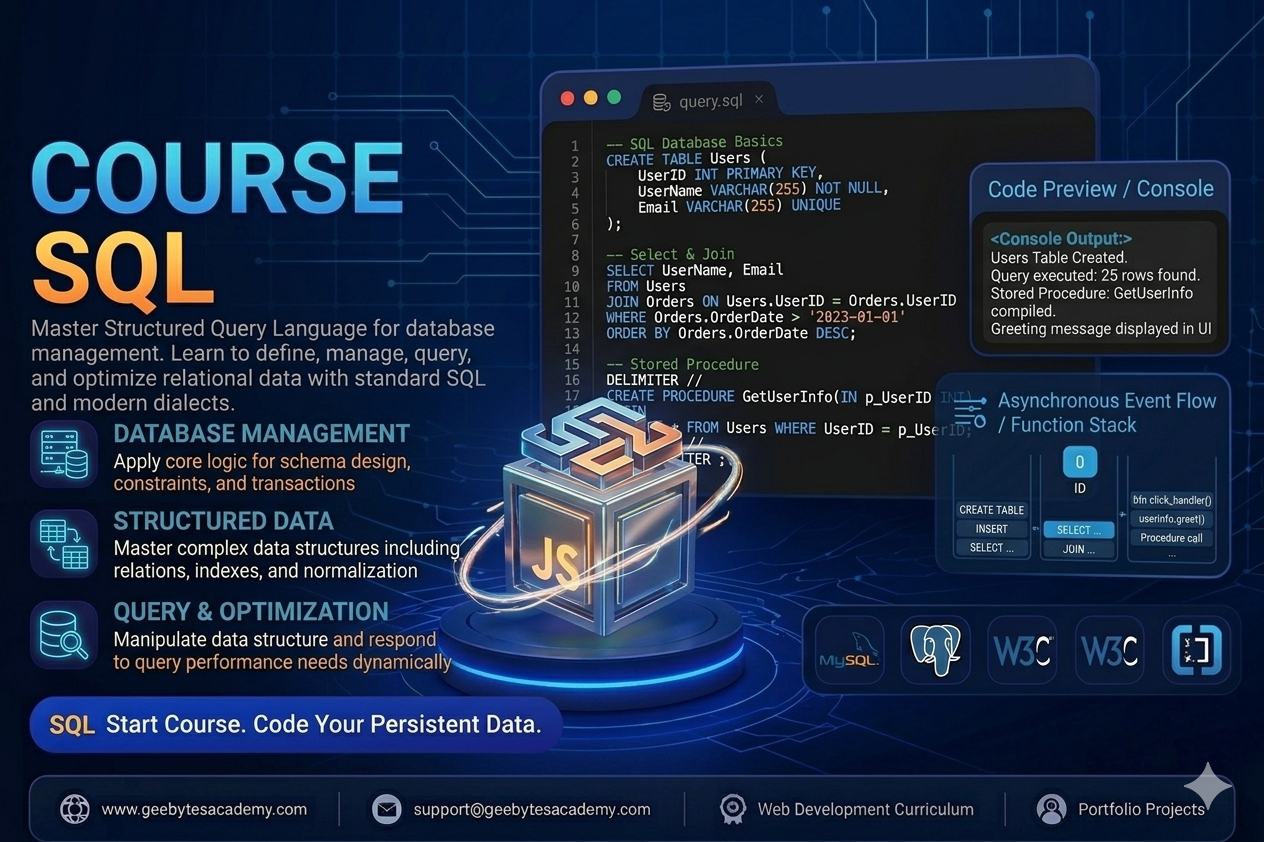
Course Overview
Level: Beginner to Intermediate
Prerequisites: Basic computer literacy and data organization concepts
Goal: Master relational database management systems RDBMS, write highly optimized SQL queries, design normalized schemas, and manage enterprise data assets.
Module 1: Relational Database Foundations and SQL Basics
Introduction to Databases: Understanding file storage versus relational databases and the role of a Relational Database Management System RDBMS.
Database Ecosystems: Setting up tools like MySQL, PostgreSQL, or SQLite and understanding database clients.
SQL Language Subsets: Differentiating between Data Definition Language DDL, Data Manipulation Language DML, and Data Control Language DCL.
The Core Query Engine: Writing basic data retrieval statements using SELECT, FROM, and terminating statements correctly.
Module 2: Filtering and Sorting Data Records
Conditional Filtering: Restricting data rows using WHERE clauses paired with comparison operators.
Logical Evaluation: Combining multiple filter layers using AND, OR, and NOT logical operations.
Pattern Matching: Performing text search filtering using LIKE, wildcards, and IN operators.
Null Value Handling: Checking for missing dataset values using IS NULL and IS NOT NULL.
Ordering Output: Sorting query results alphabetically or numerically using ORDER BY with ascending or descending parameters.
Module 3: Data Manipulation and Table Modifications
Inserting Records: Adding single or multiple dataset rows into database structures using INSERT INTO values.
Updating Records: Modifying existing row parameters safely using UPDATE alongside strict WHERE clauses to prevent accidental table wide overrides.
Deleting Records: Removing targeted rows using DELETE FROM versus wiping full structures with TRUNCATE.
Altering Structures: Using ALTER TABLE to add columns, modify data types, or drop fields from active live structures.
Module 4: Data Integrity, Constraints, and Schema Design
Data Types: Selecting optimal storage types including integers, variable characters VARCHAR, text, booleans, dates, and timestamps.
Primary and Foreign Keys: Ensuring row uniqueness using PRIMARY KEY and linking tables together via FOREIGN KEY constraints.
Field Requirements: Enforcing data entry rules with NOT NULL, UNIQUE, CHECK, and DEFAULT values.
Database Normalization: Structuring tables across First, Second, and Third Normal Forms to eliminate data redundancy and anomalies.
Module 5: Aggregation and Data Summarization
Aggregate Functions: Computing structural summaries using COUNT, SUM, AVG, MIN, and MAX functions.
Grouping Records: Segmenting data rows into categorical blocks using the GROUP BY clause.
Filtering Aggregates: Restricting summarized datasets using the HAVING clause versus traditional row filtering with WHERE.
Removing Duplicates: Filtering unique records out of saturated columns using the DISTINCT modifier.
Module 6: Querying Multi Table Datasets Joins and Subqueries
Understanding Table Relationships: Navigating One to One, One to Many, and Many to Many schema architectures.
Inner Joins: Retrieving rows that have matching values in both connected tables using INNER JOIN.
Outer Joins: Preserving unmatched rows across data structures using LEFT JOIN, RIGHT JOIN, and FULL OUTER JOIN patterns.
Subqueries: Nesting queries inside other queries within SELECT, WHERE, or FROM clauses to perform complex multi-stage computations.
Module 7: Database Optimization, Views, and Transactions
Database Indexes: Accelerating query response speeds on massive datasets using CREATE INDEX features.
Database Views: Saving complex multi-join queries into reusable virtual structures using CREATE VIEW.
Database Transactions: Ensuring absolute data reliability using ACID properties with COMMIT and ROLLBACK command controls.
Capstone Portfolio Projects
To graduate from this course, students will complete two enterprise grade database projects demonstrating structural schema layout and query optimization mastery:
Project 1: An E Commerce Platform Relational Database Architecture
Students will design and implement a relational database schema for a digital retail store from scratch. The project involves building highly normalized tables for users, products, categories, orders, and order items. Students must write complex analytical scripts to generate business performance reports, calculating top selling products, monthly revenue data summaries, and average customer lifetime value spending metrics via advanced multi table joins.
Project 2: A Corporate Human Resource Management System Engine
Students will build a database core capable of tracking employee profiles, department hierarchies, payroll histories, and performance reviews. This project focuses heavily on implementing strict data integrity constraints, indexing frequently accessed data paths for rapid report loading, and configuring transactional blocks to handle multi table payroll distributions safely without system failures.